The task wasn’t complicated. The system around it was.
Systems we’ve built.
Different businesses.Different bottlenecks.Different solutions.
System 01 / 03
01
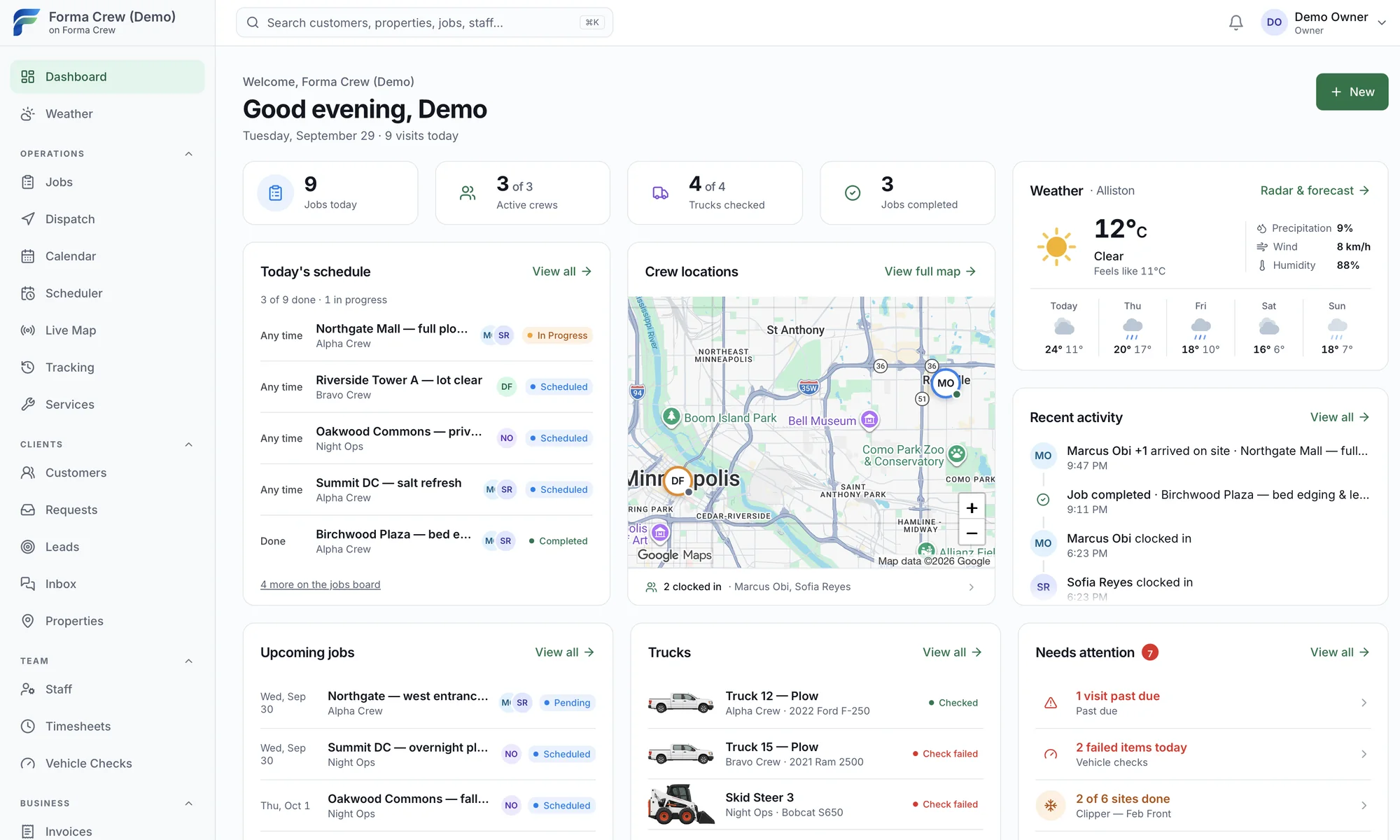
Forma Crew
Operations software for service businesses
Problem
Crews, schedules and customers were run from spreadsheets, texts and emails.
What we built
One platform connecting scheduling, crews, customers and billing.
What changed
Office, crews and clients now work from the same live picture.
02
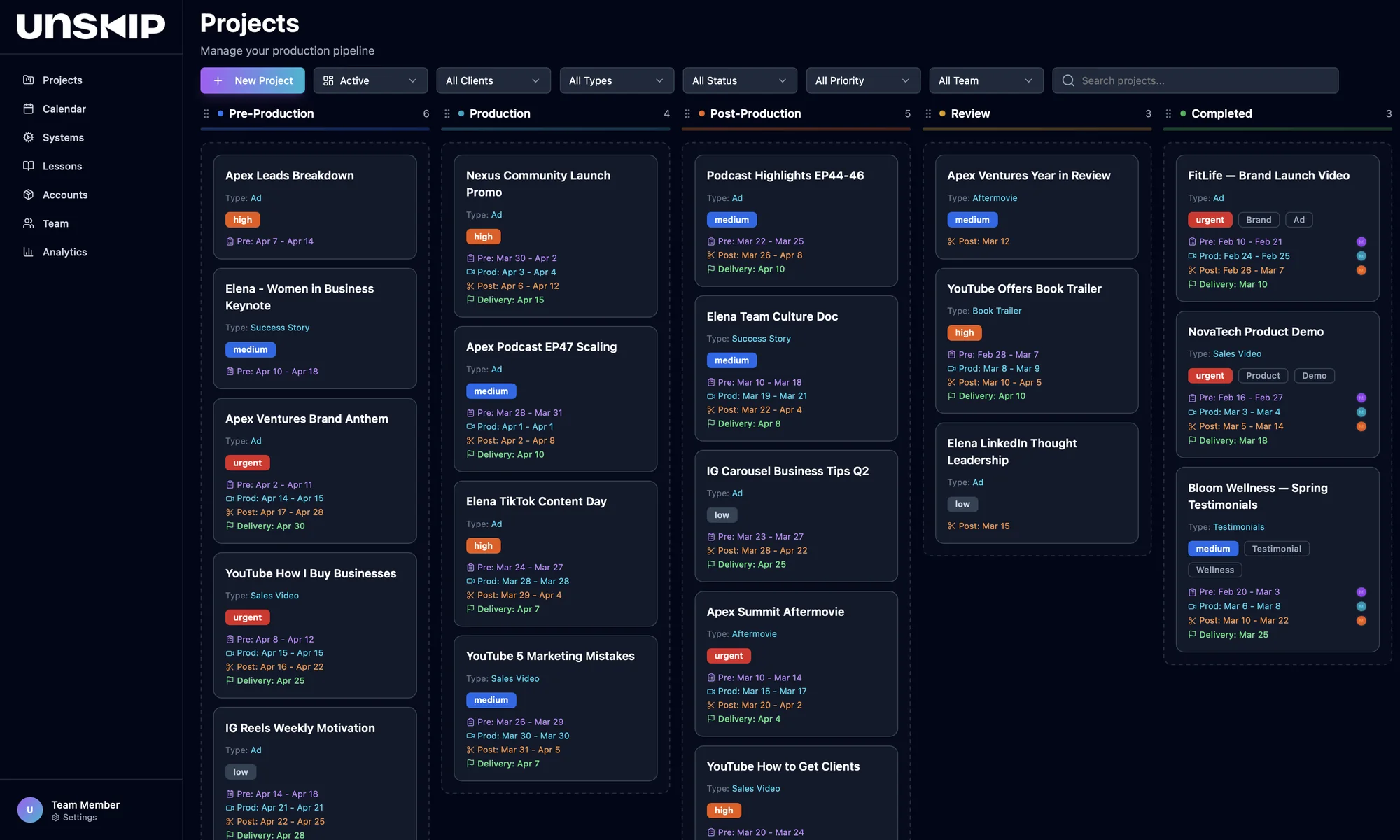
Unskip
Project management for a video production agency
Problem
No visibility into team capacity or realistic delivery timelines.
What we built
A capacity-aware production hub with automated project intake.
What changed
We commit to timelines we can actually hit.
03
Mantini Motors
3D configurator for a custom motorcycle builder
Problem
Customers couldn’t picture their custom build before buying.
What we built
A real-time 3D configurator to design and price any build.
What changed
Buyers now see, price, and order their exact motorcycle instantly.
Before we build anything
We find what actually needs fixing.
The Constraint
What’s actually slowing the business down.
The Cost
What it’s costing in time, money or manpower.
The Move
What should happen first.
Klenoa
Operational Constraint Report
No. 0001 · Example
Northside Service Co. · sample business
Primary constraint
Every quote over $5,000 waits for the owner to review pricing before it can be sent.
The cost
Illustrative calculation · sample figures
66 hrs
Weekly
2626 hrs
Monthly
$62,400$62,400
Annual cost
Estimated annual cost of the constraint.
The working: 6 h a week × 52 = 312 h a year of owner time. At an illustrative $200/h opportunity cost, $62,400 a year, before counting the revenue that waits while quotes sit in the queue.
01 · Where time is lost
The owner reviews every quote over $5,000, costing 6 hours a week.
02 · Where information breaks
Pricing rules live with the owner, so nobody else can approve quotes.
03 · What should disappear
Owner review of quotes that follow standard pricing.
04 · What should connect
The quote builder and a written pricing guide.
05 · What should be automated
Flagging only the quotes that fall outside the pricing rules.
06 · What to build
A focused solution that removes the bottleneck without adding complexity.
Recommendation
Write the pricing rules down, let the team send quotes that follow them, and route only the exceptions to the owner.
Example report · illustrative figures · Klenoa
The Constraint
What’s actually slowing the business down.
The Cost
What it’s costing in time, money or manpower.
The Move
What should happen first.
Build only what the solution requires.
We don’t overcomplicate the solution just because we can. We build the simplest solution that solves the actual problem.
01
Remove
Eliminate steps that don’t create value.
02
Simplify
Make the process easier to execute.
03
Connect
Connect the systems that need to work together.
04
Automate
Automate repetitive work where it creates leverage.
05
Build
Custom solutions that create leverage.
How Klenoa works.
01
Find
Identify the biggest constraint.
02
Map
See how the work actually flows.
03
Fix
Design the simplest solution.
04
Refine
Measure, improve and support.
When the problem needs a deeper look
We map the whole operation.
See where work waits, gets repeated, and depends on someone remembering.
Systems Blueprint01 / 06
01
Current state
How work actually moves through the company today.
ARe-typed twice between request and invoice
BScheduling waits on one person
CJob history lives in a spreadsheet
Northside Service Co. · sampleIllustrative
Systems Blueprint03 / 06
03
Cost analysis
What each constraint costs in time, money and people.
Job → invoice handoff$27,400
Scheduling by text$15,900
Owner approvals$9,300
Duplicate customer entry$6,100
Working shown · assumptions labelled
Northside Service Co. · sampleIllustrative
Systems Blueprint04 / 06
04
Future state
What stays, what connects, what’s replaced, what’s built.
Keep
Accounting platform
Connect
Requests → jobs → invoices
Replace
Spreadsheet scheduling
Build
Where it creates leverage
Northside Service Co. · sampleIllustrative
Systems Blueprint03 / 06
03
Cost analysis
What each constraint costs in time, money and people.
Job → invoice handoff$27,400
Scheduling by text$15,900
Owner approvals$9,300
Duplicate customer entry$6,100
Working shown · assumptions labelled
Northside Service Co. · sampleIllustrative
Illustrative Systems Blueprint · sample operation
The blueprint is yours.
Implement it with us or your team.
Run a simpler, more profitable business.
Tell us what’s getting in the way. Get a free Constraint Report showing the cause, the cost, and the simplest way forward.